
Any team already using generative AI to produce work knows the symptom. The first draft is acceptable. The second drifts a little. By the fifth, you don’t recognize it. Nobody decided to change the brand, but the brand has changed anyway, one degree per cycle, until one day you open a landing page shipped last week and can’t tell what company it belongs to.
Call it identity drift. It’s what happens when AI produces the work but the brand still lives where only humans can read it.
Where the brand lives
Your brand probably lives in good shape. A Figma library with Variables and components. A brand portal on the web. A Notion page the team bookmarks. A senior designer who reviews the final pass. None of that is broken. None of it is what the AI reads.
Brand portals are optimized for human consumption: visual, browseable, narrative. The AI needs the same source in a different shape. AI didn’t create that gap. It made it visible. And now it produces against the gap at scale.
Move the brand to where the AI reads
If the AI produces, the brand has to live where the AI reads. Plain text, structured, in a single source, accessible to any tool your team opens tomorrow. Not as a replacement for your Figma library or your brand portal. As the layer the AI can actually read.
In April 2026 Google published the DESIGN.md spec under Apache 2.0: an open format that combines YAML for exact tokens with markdown for rationale, intent, and use cases. Any LLM reads it natively. So do agentic builders that follow the spec. So does any code editor with file access. It’s the brand turned into something machines can parse and humans can keep editing with a commit.
That’s the foundation we built The Agile Monkeys Brand Hub on.
The system
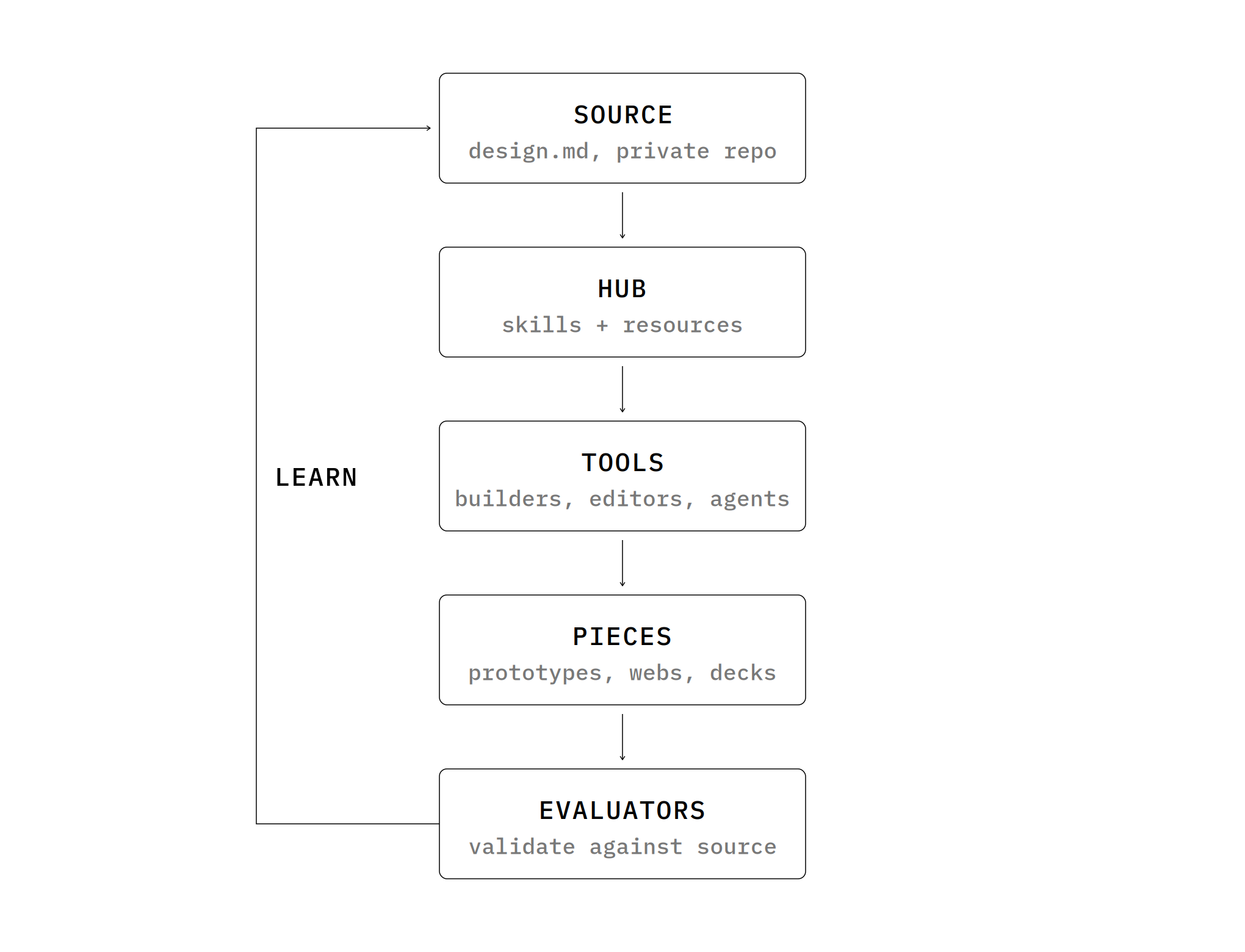
A single source: the DESIGN.md in a private repo. A hub that distributes it alongside SVG logos and ready-to-paste prompts. The tools your team uses for generative work read from the hub: agentic builders like Lovable, v0 or Bolt, AI code editors like Cursor, CLI agents like Codex or Claude Code. They produce a first pass. Humans iterate on it according to what the piece needs. Evaluators check that the iteration didn’t pull it off-brand. The loop closes.
Two kinds of prompts live in the hub: generators that produce, evaluators that judge. They never combine. It’s the same rule that keeps author and reviewer apart in any healthy process. Both are loadable, so any tool that reads markdown picks up the right one when it starts a project. That’s what turns a brand portal into something machines can operate.
The loop that matters: apply, correct, learn
Most teams stop at produce, validate, publish. The interesting loop runs one step further: produce, validate, learn.
The evaluator doesn’t block publication. It informs. Each gap comes with cause and consequence, and three open paths for the user: correct, publish with a notification to the brand guardian, or reevaluate whether the piece is in the right lane. When the user picks correct, the evaluator hands over a ready-to-paste prompt with the fixes. It never edits the piece itself. That keeps producer and judge separate by mechanism, not just by principle. The system’s authority lives in what it offers. Forbidding is not how it works.
If the evaluator keeps flagging the same gap across different pieces, that’s the system asking for adjustment. The pieces are doing their job. They’re surfacing where the source has gone stale. Every use becomes signal. Each piece that passes validates the system. Each piece that breaks refines it.
Updating the system means editing a file
A new decision (a component, a rule, a tone) opens a PR to the DESIGN.md from GitHub’s web UI. No terminal, no Git CLI, accessible to non-technical people. Automation handles what’s technical. Human guardians judge whether the change makes sense for the brand.
Once merged, the change is live. New pieces consume the new version automatically. Nothing else needs rebuilding. The source changed, and everything that reads it keeps reading it.
The window
The first draft is already on-brand, and AI speed stops fighting brand quality because the brand is already inside the prompt. The system also gets smarter with use: evaluations don’t only improve pieces, they move the system. The brand doesn’t petrify. It grows because coherence lives in the file, and the file is editable.
A brand only humans can read doesn’t survive AI. Your team already uses generative tools to produce. The open question is whether your brand can survive that production without you watching every piece.
We built this for ourselves, and it’s already producing. Brands hold their shape over the next two years if their guidelines are where the AI can read them. Otherwise the AI writes the brand.